

Honolua Bay snorkeling is best between May and September when summer swells flatten and underwater visibility hits 40–60 feet. Skip the sandy center enter from the rocky north shoreline, wear booties, and show up before 9 AM. You’ll need reef-safe sunscreen, a silicone-seal mask, fins, and a rash guard. No facilities exist on-site, so pack everything before you leave.
I’ll be straight with you I almost skipped Honolua Bay on my first Maui trip. A friend told me the trail was muddy, the rocks were slippery, and there was no beach to lay on. All of that is technically true. What he forgot to mention was that the moment you duck below the surface on the north side of that bay, you realize you’re looking at one of the healthiest reef ecosystems left in the entire Hawaiian island chain.
That tends to change your perspective pretty fast.
Honolua Bay snorkeling sits in a different category from your typical Maui beach stop. There’s no lifeguard stand, no shave ice truck idling in the parking lot, no roped-off swimming area with color-coded flags. What there is and what keeps locals coming back year after year is an officially designated Marine Life Conservation District with decades of no-fishing protection behind it. The fish here don’t scatter when you swim toward them. They just hang there, going about their morning. It’s the kind of thing that feels almost surreal the first time you see it.
This guide covers everything you actually need to know before you go gear, timing, exactly where to enter the water, what you’ll see down there, and whether a guided Honolua Bay snorkeling tour makes sense for your situation.
Why Honolua Bay Is Different From Every Other Maui Snorkel Spot
Here’s the short version: no fishing, ever, for decades. That’s the whole reason the reef looks the way it does.
Most snorkeling spots in Hawaii even the popular ones exist along coastlines where recreational fishing happens constantly. Fish get spooked, populations thin out near shore, and coral takes incremental damage from anchors, feet, and careless fin kicks. Honolua Bay operates under a completely different set of rules. The Marine Life Conservation District designation means zero fishing of any kind no hooks, no nets, no spearfishing. Period. Break that rule and you’re looking at serious fines.
What you get from decades of that kind of protection is an underwater world with density and variety that’s genuinely hard to find outside of protected marine preserves. The fish have never been hunted here. Parrotfish, jacks, and turtles move through the water with the confidence of animals that have never once had a reason to be afraid.
The bay itself is shaped by high volcanic cliffs on both the north and south sides, which do two useful things: they block the trade wind chop that hammers so much of Maui’s coastline, and they create a sheltered pocket of water that stays calm on most summer mornings. The center of the bay looks out across the Pailolo Channel toward Molokai. On a clear day, that view is its own reward.
There’s also a surf break at the north point that some surfers consider the most perfect wave in Hawaii. In winter that wave makes the bay completely inaccessible for snorkeling more on that in a moment.
When to Go: A Real-Talk Seasonal Breakdown
Getting the timing wrong for Honolua Bay snorkeling isn’t just disappointing in winter, it can be genuinely dangerous. The bay swings between two completely different personalities depending on the season, and most tourists don’t realize this until they’re standing on the rocks staring at six-foot whitewater.
Summer (May through September) — This Is Your Window
From late spring through early fall, the north Pacific swells flatten out and Honolua Bay turns glassy. Some mornings the surface looks like a photograph so still you can see the shadow of your fins on the reef 15 feet down before you even enter the water. Visibility on a good summer day regularly runs 40 to 60 feet. Sometimes more.
Late June through August is peak season within peak season. May can still catch the tail end of a spring swell, and September occasionally gets a surprise early-season north bump, but those months are still vastly better than winter. If you’re booking a Maui trip specifically for snorkeling in Honolua Bay, July and August are your safest bets for consistent flat conditions.
Within any given day, mornings win by a wide margin. Trade winds along Maui’s northwest coast typically pick up somewhere between 10 AM and noon. By early afternoon the surface has chop, the water around the entry rocks gets bouncy, and visibility drops a notch. Get there between 7 and 9 AM and you’ll have a fundamentally different experience than the folks who roll up at 11:30.
Winter (November through March) — Don’t Even Try It
Honolua Bay in winter belongs to the surfers. North swells roll in, the bay transforms into a world-class break, and the snorkeling conditions go from extraordinary to actively hazardous. We’re talking waves that can reach 10 to 20 feet on a big swell, murky water from churned-up sediment, and currents that have no business being underestimated.
If your trip falls between November and March, you’re not out of options Turtle Town near Maluaka Beach and Olowalu (the Coral Gardens spot) stay calm year-round and are legitimately excellent. Just let Honolua Bay sit out the winter season.
Spring and Fall (April and October) — Check Before You Go
These transitional months are genuinely unpredictable. You could show up to mirror-flat water and a private reef experience, or you could find two-foot chop and sketchy entry conditions. The way to handle it: check NOAA’s surf forecast for Maui’s north shore the night before, cross-reference with Surfline or Magic Seaweed, and make your call in the morning. Don’t just assume it’ll be fine.
For a full month-by-month breakdown across all of Maui’s coastlines, check our guide to the best time to snorkel in Maui
The Complete Gear Checklist for Honolua Bay
You can rent snorkel gear near Kapalua or down in Lahaina, and that’s a totally reasonable option. But if you’re going to do this bay justice, the quality of your equipment matters more here than it would at a calmer, shallower beginner spot. Rocky entry, active reef, variable conditions cheap gear introduces problems you don’t need.
A silicone-seal mask. Nothing matters more than getting this piece of equipment right. A mask that fits properly creates a suction seal against your face and doesn’t let water creep in. Cheap plastic-skirt masks leak constantly, fog up, and turn a great session into a miserable one. When renting, specifically ask for a silicone skirt and test the seal on dry land before you ever touch the water. Press it against your face without the strap, inhale through your nose it should stick without you holding it. If it doesn’t fit well, don’t hesitate to request another size.
Skip full-face snorkel masks for Honolua Bay. They work fine for shallow, calm water but they limit your peripheral vision, make it harder to equalize if you dive down to peek at something, and they can fog up in ways that are harder to fix mid-session.
Fins. Either full-foot fins or open-heel fins with booties work. Given that Honolua Bay has a rocky entry there’s no soft sandy beach on the good side booties or water shoes make a meaningful difference in how confident and stable you feel walking across those rocks. Open-heel fins with a neoprene bootie give you foot protection for the walk and solid fin performance in the water.
Booties or water shoes. Even if you go with full-foot fins, bring something to walk the rocks in before you swap to your fins at the water’s edge. The rocks between the boat ramp and the north entry can be slippery, uneven, and occasionally sharp. Always make sure your feet are properly covered here.
A UV rash guard or 2mm shorty wetsuit. Hawaii water stays between about 74°F and 80°F year-round. That feels wonderful for the first 20 minutes and then starts to feel like a slow cool bath around minute 40. A thin wetsuit or a full-coverage rash guard solves two problems at once the mild chill and the sunburn on your back that you won’t notice happening until you’re back at your rental and have already done real damage.
Reef-safe mineral sunscreen. Hawaii law prohibits sunscreens containing oxybenzone and octinoxate they’re banned for sale in the state because of documented coral bleaching effects. Bring a zinc oxide or titanium dioxide mineral sunscreen from home, or better yet, cover up with a rash guard and minimize how much sunscreen you’re putting into the water at all.
Anti-fog drops or solution. Even a genuinely good mask needs help. A few drops of commercial defog solution, shaken around and rinsed out before you enter, is the difference between clear sight lines and a fogged-up frustrating first five minutes.
Worth Packing If You Have It
An underwater camera or GoPro with a wrist mount is worth its weight here. The marine life density in Honolua Bay makes for footage that’s genuinely hard to get anywhere else on Maui without hiring a boat. A mesh gear bag or dry bag for your phone, wallet, and car keys is also smart there are no lockers anywhere near the bay. And bring more water than you think you’ll need; the trail walk plus the swim is more exertion than most people expect, and there’s nothing to buy anywhere nearby.
Getting There: Directions, Parking, and the Trail Down
The address to put in your GPS: Honolua Bay, Kapalua, HI 96761. You’re looking for a roadside gravel pullout on the mountain side (mauka) of Honoapiilani Highway Route 30 roughly 2 miles north of the Kapalua resort entrance.
From Kahului Airport, you’re looking at about 1 hour and 10 minutes depending on traffic through Lahaina. From Lahaina itself, it’s 25 to 30 minutes north on Route 30.
Parking is free, which is nice. What’s less nice is that there are maybe 20 to 30 spots total, and on any summer weekend between June and August, those fill before 8:30 AM. If you’re driving up on a Saturday in July and it’s already 9:15, accept that you’re probably going to be parking along the highway shoulder and adding some walking distance. Plan accordingly, or just get there earlier than feels necessary.
From the parking pullout, you follow a well-worn dirt trail maybe 100 meters, takes about 3 to 5 minutes through a canopy of trees that keeps it shaded and somewhat cool. You cross a dry (or occasionally trickling) stream bed partway down, and that’s when you know the beach is close. The path pops out right at the old concrete boat ramp that splits the shoreline in two.
Where to Actually Enter the Water — This Changes Everything
This is the part most articles gloss over, and getting it wrong is how you end up spending your first 10 minutes swimming through murky nothing wondering what all the fuss was about.
Don’t Enter at the Sand (Left of the Boat Ramp)
To the left of the boat ramp, the shoreline is dark grey powdery sand where a seasonal stream flows into the bay. That stream runoff, combined with the fine sediment, keeps the nearshore water cloudy and green-ish. You can get past it if you swim out far enough, but why would you start there when the actual reef is in the opposite direction?
Enter from the North Side — Right of the Boat Ramp
Turn right from the boat ramp and pick your way carefully along the rocky shoreline heading north. Yes, it takes a few minutes. Yes, the rocks are uneven. That’s why you’re wearing booties. When you reach a point where you’ve got water lapping against the rocks and you can see coral below the surface, that’s your entry spot.
Sit down, get your fins on while you’re still on dry rock, then slide in feet-first. Don’t attempt to walk into the water wearing fins it’s a recipe for a stumble and a scrape. Once you’re in, drop your face in, take a breath, and you’ll immediately see why this spot has the reputation it has.
From there, swim north along the rocky edge. The reef deepens and gets more elaborate as you move toward the north point. The middle of the bay the open sandy area runs 15 to 20 feet deep, and while you’ll occasionally see schools of fish crossing it, the real action is along the reef wall.
Marine Life at Honolua Bay: What's Actually Down There
Because of how long this bay has been protected, the fish here behave differently than at most spots. They don’t bolt. A parrotfish will crunch through coral two feet from your mask like you’re not even there. A hawksbill turtle might surface for air directly underneath you. It can feel, on a good morning, a little bit like being invisible inside an aquarium.
The Fish List — and It’s a Long One
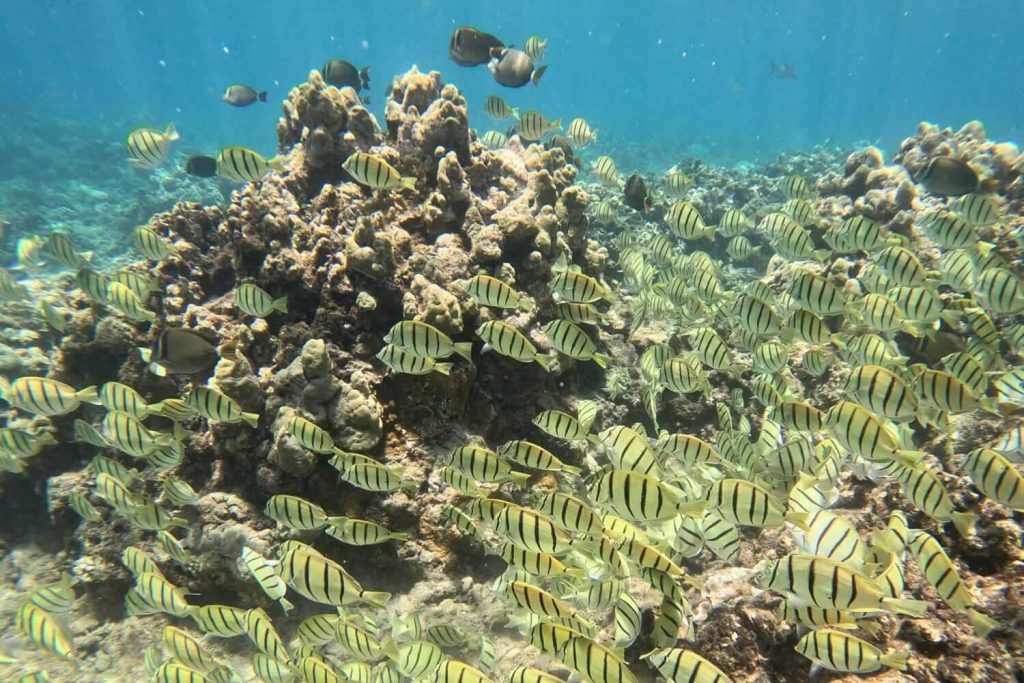
You’re going to see parrotfish in vivid blues and greens (you can actually hear them biting coral a sharp clicking sound), moorish idols with their dramatic black-and-white patterns and trailing dorsal fins, butterflyfish darting in pairs, convict tangs schooling in loose silver packs, the humuhumunukunukuapuaa (Hawaii’s state fish the reef triggerfish, and yes, worth learning to say for the dinner table story alone), wrasse in a dozen color variations, damselfish aggressively defending their algae patches, squirrelfish tucked under coral ledges, and jacks patrolling the outer edges in loose, fast-moving groups.
On good days and people who snorkel in Honolua Bay regularly will tell you this you might see spotted eagle rays gliding low over sand, barracuda pushing five feet or better, or manta rays on rare visits. Schools of big-eye scad pack into the open center of the bay in rotating silver curtains that catch the light in a way that’s hard to describe and easy to remember.
Turtles — Read This Before You Get In
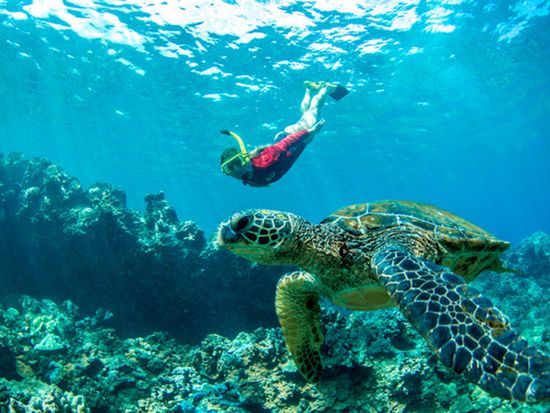
Hawaiian green sea turtles, honu, show up regularly on the north reef side. They are protected under both federal and Hawaii state law, and the rules are not suggestions: stay at least 10 feet away, don’t touch them, don’t chase them, and absolutely don’t try to ride them (this actually happens, and it’s both harmful and illegal). The best turtle encounters happen when you stop moving, float flat, and let the animal close the distance on its own terms. They will, often, once they sense you’re not a threat.
Eels, Octopus, and Coral
Check crevices and the undersides of ledges for moray eels both the Hawaiian dragon moray and the whitemouth variety are here. Octopus are technically abundant but almost impossible to spot until you know what a relaxed octopus looks like pressed against a rock (hint: a subtle texture shift and a slight color variation). Sea urchins populate the shallower rocky zones near the entry don’t put your hands down without looking, and watch your fin kicks in tight spots.
The coral itself antler, cauliflower, and lobe formations throughout is what makes all of this marine life possible. Never stand on it. Never grab it. A single contact from a fin tip can kill years of coral growth.
Should You Book a Honolua Bay Snorkeling Tour?
Snorkeling in Honolua Bay on your own is realistic for most adults who are comfortable in the ocean. The trail is clear, the entry once you know where to go is manageable with the right footwear, and the reef is obvious once you’re in the water. Independent snorkelers do this bay every single day without incident.
That said, a guided Honolua Bay snorkeling tour genuinely earns its price in specific situations.
If you’re new to open-water snorkeling and want someone to walk you through mask clearing, breathing technique, and how to handle an unexpected wave that instruction is worth paying for. If you don’t want to deal with gear logistics (renting, returning, lugging equipment), a tour that includes gear as part of the package simplifies everything. Families with young kids benefit from having a guide in the water watching the group. And if you want to combine Honolua Bay with other northwest Maui spots like Honokohau Bay or Kapalua in a single morning, several operators run exactly that kind of multi-spot tour.
If you’re not confident in the water at all, our guide to snorkeling for non-swimmers in Maui walks through flotation gear and technique before you ever get in.
When you’re comparing Honolua Bay snorkeling tours, look for operators with small group sizes anything over 12 people starts to feel crowded on that reef. Ask whether they carry state permits, whether their guides offer species identification in the water (not just a briefing on shore), and whether they emphasize reef-safe practices explicitly. Tours typically run $80 to $150 per person for a half-day experience out of Lahaina or the Kapalua area.
Facilities, Packing List, and the Stuff No One Tells You
Here’s the honest rundown on facilities: there aren’t any. No lifeguard. No bathrooms. No outdoor shower. No food. No water. No gear rental. No cell service worth relying on. The nearest anything is a few miles south toward Kapalua.
Everything you need for your day goes in your bag before you leave wherever you’re staying.
Packing list for Honolua Bay:
- Full snorkel set — mask, snorkel, fins
- Booties or water shoes (non-negotiable for this location)
- Reef-safe mineral sunscreen
- UV rash guard or 2mm shorty wetsuit
- At least 2 liters of water per person Hawaii heat plus snorkeling plus a trail walk adds up fast
- High-calorie snacks granola bars, trail mix, whatever sustains you
- Dry bag for your phone, wallet, and keys
- Towel and a change of dry clothes for the drive back
- Basic first aid — tweezers for sea urchin spines, just in case
One thing worth mentioning: the trail back up after snorkeling, while only 100 meters, is uphill and in full sun by mid-morning. That’s when the water you brought starts to feel like the smartest decision you made all day.
Safety — The Short Version
Never snorkel alone here. Always have a buddy in the water and at least a loose plan for what you’ll do if something goes wrong. Check conditions before you enter whitewater, active surf, or a strong lateral pull means abort, not push through. Don’t overestimate your swimming fitness; the round trip from the north entry out to the reef and back is 400 to 600 meters of actual swimming. If you feel a current pushing you sideways, swim at an angle toward shore rather than straight against it. In the rare case you need help, wave one arm clearly above your head two arms can look like a friendly wave to someone onshore.
And follow the rules of the Marine Life Conservation District: no touching, no collecting, no feeding anything. It’s illegal, you’ll get a fine, and more importantly, this reef exists in the condition it does because people before you respected those rules.
Frequently Asked Questions
Is Honolua Bay snorkeling good for beginners? It can be, during summer months when conditions are calm but it requires more preparation than a typical beginner beach. The rocky entry on the north side where the reef is best means you need booties, patience, and willingness to move slowly across uneven ground before you get in. If you’re a true first-timer, consider booking a guided Honolua Bay snorkeling tour. A guide can help with breathing technique, mask clearing, and water entry in ways that make the whole session dramatically more comfortable.
What’s the best time of year to snorkel at Honolua Bay? May through September, with late June through August being the most reliably flat. Mornings before 10 AM offer calmer water and better visibility at any point in that season window.
Is there parking at Honolua Bay? Yes, a small free gravel pullout along Route 30. Capacity is roughly 20 to 30 vehicles. On summer weekends, it fills before 8:30 AM. Arrive early or be prepared to park along the highway and walk farther.
Will I see sea turtles snorkeling in Honolua Bay? Regularly, yes — particularly on the north reef side. Federal and state law requires a 10-foot minimum distance. The best way to see them up close is to float still and let them approach you.
Can I rent gear at Honolua Bay? No — there’s no rental anywhere near the bay itself. Nearest options are in Kapalua (about 2 miles south) or Lahaina (about 10 miles south). Many people book Honolua Bay snorkeling tours that include gear as part of the package to avoid the rental logistics entirely.
Is Honolua Bay a Marine Life Conservation District? Yes. All fishing, marine life collection, and removal of any objects from the water is strictly prohibited. The fine is real and the rangers do patrol.
What marine life will I see snorkeling in Honolua Bay? Parrotfish, moorish idols, butterflyfish, humuhumunukunukuapuaa, convict tangs, jacks, wrasse, damselfish, moray eels, octopus, and Hawaiian green sea turtles are regular sightings. Spotted eagle rays, large barracuda, and occasional manta rays also appear. Fish density is genuinely exceptional compared to almost any other accessible shore snorkeling site on Maui.
How deep is the water for snorkeling? The north reef area where most of the coral and fish are ranges from about 5 feet near the rocks to 15 to 20 feet over the open sandy center. There’s enough terrain variation for comfortable surface snorkeling and recreational freediving.
What should I do if I visit in winter? Skip Honolua Bay and head south. Turtle Town at Maluaka Beach, Olowalu Coral Gardens, and Kapalua Bay all stay calm year-round and offer excellent snorkeling without the winter swell risk.
The Bottom Line
Honolua Bay snorkeling earns its reputation the hard way through decades of legal protection, consistent enforcement, and an ecosystem that has had time to recover and thrive in a way that almost nowhere else on Maui has. The lack of facilities and the rocky entry are genuinely minor inconveniences when you weigh them against what’s under the surface.
Come in summer. Get there early. Enter from the north side. Move slowly across the rocks. Bring your own water and food. And when you’re floating above that reef and a parrotfish the size of your forearm drifts past without even looking at you remember that this is what it looks like when a marine environment actually gets to be itself.
Worth the early alarm. Worth the muddy trail. Worth every minute.
“If you’re planning a snorkeling trip to Maui and want to compare spots, see our guide to the top snorkeling spots on Maui for a full island breakdown.“