


If you only get one week for whales on Maui, make it February. The shore counts say so: in both 2025 and 2026, the last Saturday of February was the busiest count day of the winter, with 802 whales one year and 847 the next. Late January came close, at roughly 82 to 88 percent of that. By the last Saturday of March the number had fallen to between 17 and 38 percent. The season itself runs from about November to May, according to the Hawaiian Islands Humpback Whale National Marine Sanctuary, and most tour operators run daily trips from December 1 or 15 until mid-April or later.
That’s the short version of whale watching season maui. The rest of this guide shows where the numbers come from, what’s different this year, and how to choose a tour that suits you.
Why the season dates you find online don't match
Search for when whale season starts on Maui and you’ll get answers from October to May. They’re all a little bit right. Whales don’t follow a calendar, and tour operators pick their own start and end dates based on boats, crews and bookings. Ultimate Whale Watch & Snorkel and Maui Whale Adventures open on December 1 this year. Go Whale Watching Maui starts on December 15. We start on December 15.
The sanctuary’s own line is November to May. And whales turn up earlier than the boats do: last season’s first Maui humpback was reported on September 21, 2025, by Sea Maui Catamarans, and passed along through the nonprofit Whale Trust. So a November whale is real, but sparse. Treat the operator calendar as the date the boats run, not the date the whales arrive.
November 6th – first one I spotted from my kayak at Olowalu, mother and calf breaking surface beyond the reef, I paused and let the boat move with the currents while they swam by, maintaining our standard distance. There’s something irreplaceable about that first spout of the year. Years of watching humpbacks and the thrill hasn’t faded.
What the shore counts actually show
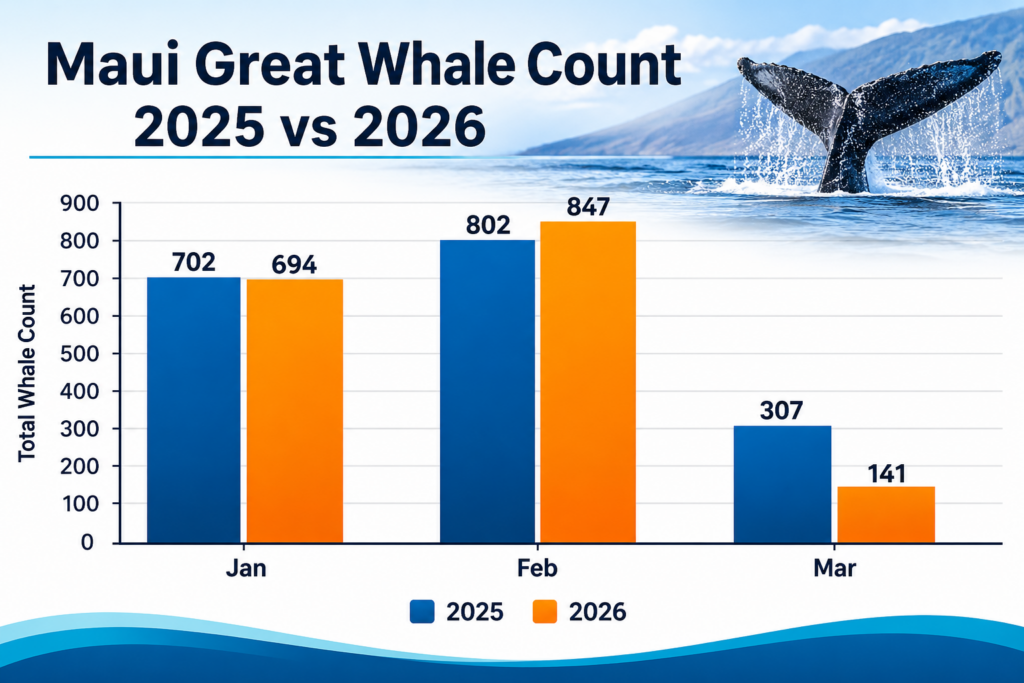
Every winter, volunteers with Pacific Whale Foundation’s Great Whale Count stand at 11 or 12 shore sites around Maui on the last Saturday of January, February and March. They count from about 8:30 to 11:50 in the morning. It’s the most consistent record we have of how whale numbers rise and fall through the season. It’s also a snapshot, not a census: one whale that surfaces three times can be counted three times, so compare months with each other instead of reading the totals as a population.
Count day (last Saturday) | 2025 | 2026 |
|---|---|---|
Late January | 702 | 694 |
Late February | 802 | 847 |
Late March | 307* | 141** |
January as a share of February | 88% | 82% |
March as a share of February | 38% | 17% |
*Preliminary figure; later reporting listed 333. **Severe weather cancelled some sites and fewer volunteers took part.
Two things stand out. February won both years, and January wasn’t far behind. January 2026 (694) was almost level with January 2025 (702), and February 2026 (847) ran 6 percent above February 2025 (802), so the winter looked steady. For what it’s worth, the February 2024 count was 948.
Then there’s March: 307 in 2025, 141 in 2026. Before you read that as “the whales left,” know that the Maui News reported a 54 percent drop in Maui County against the same day in 2025, and that weather knocked out some counting sites. We wouldn’t lean on that 141. The counts also stop at the last Saturday of the month, so they say nothing about early March, and nobody counts in December or April. Anything we say about those months comes from operators, not from this data.
If you’d like to count whales yourself, the next three count days are January 30, February 27 and March 27, 2027. Volunteers sign up through Pacific Whale Foundation on Maui, or through oceancount.org on the other islands. McGregor Point is one of the Maui sites.
Month by month
November is for the patient. The sanctuary’s season has started, and with luck you’ll spot a blow from a highway lookout, but most boat tours aren’t running daily yet.
December is when the boats start. Whale numbers are still building and nobody counts that month, so we can’t hand you a figure. Go Whale Watching Maui calls December the month with the fewest boats on the water, which is a fair way to put it if you’d rather have the channel quiet and don’t mind fewer whales.
From late January the sanctuary describes numbers at their peak, and the counts agree: 702 in 2025 and 694 in 2026 on the last Saturday of January, then the high of the winter in February.
February mornings near Olowalu begin early, around 6:30 or 7, with calm waves mirror-like, gentle glow fading across Lanai. Often a whisper turns audible – then foam appears, usually near the reef’s edge – whales surfaces rise fast. So near do they come that paddling slows, sometimes halts, eyes fixed on their deep breathing. Before ten, wind stirs, whispers grow into steady pulses, signals time to pull toward shore. Faces salty, hearts full, we turn toward town, conversations already weaving images into tales.
March is where people get nervous. Early March is probably still strong, though no count measures it. By the last Saturday the numbers were clearly lower in both years, and operators often point to mothers with calves as the reason to go late. We wrote a separate piece on whether March is too late.
April is the long goodbye. Go Whale Watching Maui closes on April 12 and Maui Whale Adventures on April 30. Trilogy ran whale sails out of Lahaina Harbor through mid-April last year. By May, sightings are rare, even though the sanctuary’s season officially runs through the month. For the end of the season, see when the whales leave Maui; for the start, when the whales come to Maui. Visiting another island? Try our Hawaii whale watching guide.
Best time of day
Morning, if you can manage it. In the 2026 counts, the busiest 15-minute window was 9:00 to 9:15 a.m. on January 31 (260 whales across all counted sites statewide) and 9:30 to 9:45 a.m. on February 28 (256). The catch is that counting stops around noon, so those figures can’t tell you whether afternoons are quieter. Go Whale Watching Maui says whale activity is fairly even through the day and tells guests to choose the conditions they prefer. We’d add one practical point: trade winds usually build later in the day, and flat water matters more on a kayak than on any other boat.
What whale watching costs, and how to pick a tour
Most Maui boat tours list somewhere between $70 and $160 per adult (operator-listed prices, October and November 2026). Go Whale Watching Maui charges $70 for adults and $50 for children on a 1.5-hour trip, and Maui Whale Adventures starts at $79. Big catamarans and whale-watch-and-snorkel combinations usually cost more. Our kayak trip starts at $99, with a 20 percent online discount. Look at the guarantee as well as the price: some operators give you a free return trip, others a refund.
Type | Typical adult price | Typical group | Good for | Trade-off |
|---|---|---|---|---|
Large or sailing catamaran | about $99 to $160 | dozens, sometimes 100+ | Families, shade, restrooms, a steady ride | Farther from the water, more people |
Small-group raft | about $70 to $130 | about 20 | Eye-level views, quick moves toward a whale | Bumpy, usually no restroom, age minimums |
Kayak (ours) | from $99 | n/a | Quiet, eye-level, live whale song | Physical, weather-dependent, age and skill limits |
Shore | free | n/a | Budget and flexibility | No guide, no close view |
On the big-boat side, Pacific Whale Foundation, a nonprofit founded in 1980 that sails from Ma’alaea Harbor, is the name most people know. Trilogy runs sailing catamarans and began whale sails from Lahaina Harbor on March 18 last season. For rafts, Ultimate Whale Watch & Snorkel has been operating since 1982, leaves from Mala Boat Ramp, and says its crew volunteers with NOAA’s Whale Entanglement Response Team. Go Whale Watching Maui runs one boat with twenty guests, and Maui Whale Adventures shuttles guests out from Ka’anapali Beach to a 20-passenger raft. We do the quiet version: kayak, whale watch and snorkel off Olowalu Beach, from $99. You can book whale watching on Maui with us here.
Prices and dates come from each operator’s website in November 2026. Check before you book.
Kayak whale watching on Maui
A kayak puts you at water level with no engine running. Our trip launches from Olowalu Beach into the Hawaiian Islands Humpback Whale National Marine Sanctuary and lasts about 3.5 hours. A custom underwater hydrophone lets guests hear whale song live.
The 100-yard rule applies to kayaks as much as to boats, and the law doesn’t care what you paddle. Whales are free to approach you, though. When one does, Hawaii’s Department of Land and Natural Resources says to stay put and let the whale move away on its own. Our guides cover that before anyone launches. The tour suits people who are comfortable on the water, and the minimum age is 5+ Wondering what to wear? See what to wear whale watching on Maui.

Whale watching from Lahaina in 2026-27
Lahaina Small Boat Harbor reopened for limited commercial use on December 15, 2025, for daytime use only (8 a.m. to 6 p.m.) and at first just for loading and unloading. Four operators returned first, and more followed in early 2026. Trilogy started whale sails from Lahaina Harbor on March 18, 2026, while many West Maui raft operators have used Mala Boat Ramp since the 2023 fire. Departure points have shifted a lot, so ask where your trip leaves from before you book. Lahaina town is still rebuilding, and our guide to visiting Lahaina in 2026 has the details.
Watching from shore
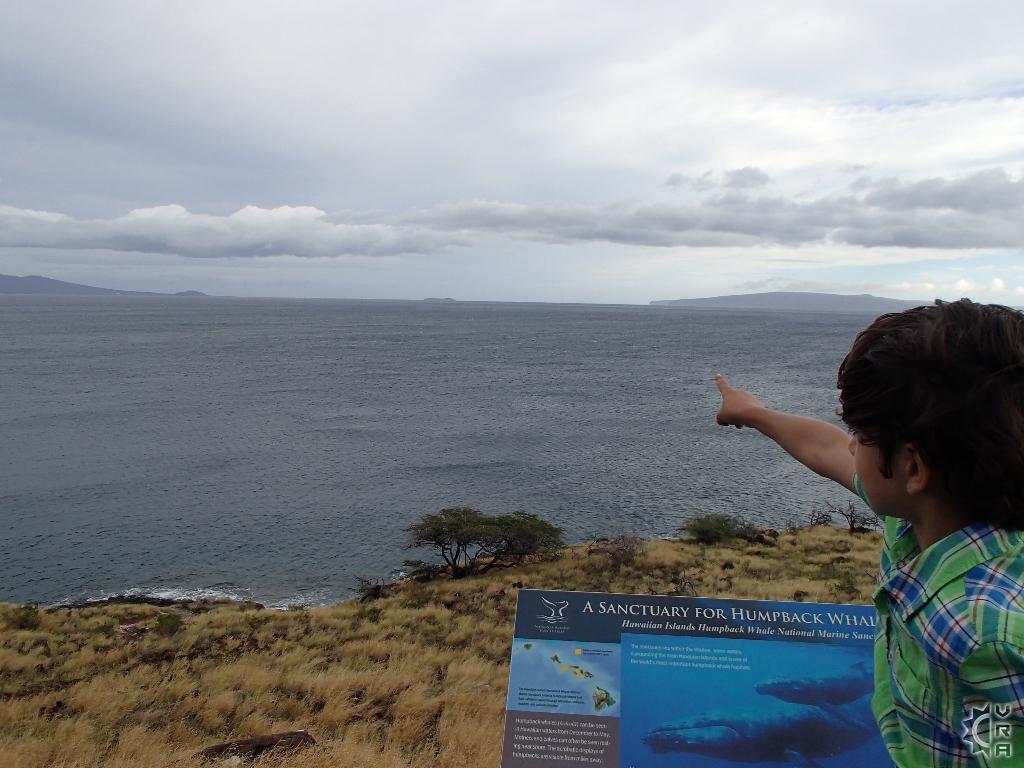
You don’t need a boat to see whales, and in peak weeks you often don’t have to hunt for them. McGregor Point and Papawai Scenic Lookout sit above the highway between Ma’alaea and Lahaina, and McGregor Point is a Great Whale Count site. The Wailea Oceanside Path, the Ka’anapali Beach walkway and the Kapalua Coastal Trail also work. Bring binoculars, scan slowly for blows and splashes, and give it at least 20 minutes. Shore watching is free but passive. A boat or kayak gives you a guide and a closer look.
The rules, briefly
- It’s illegal to approach a humpback within 100 yards by any means, including boat, kayak, paddleboard, swimmer or drone (50 CFR 224.103). Aircraft must stay 1,000 feet away.
- If a whale comes to you, stay still until it moves off.
- In November 2026 the sanctuary asked boaters to travel at 15 knots or less (or a safe planing speed) in water 600 feet deep or less, and at 6 knots or less within 400 yards of a whale.
- To report an injured or entangled whale, call the NOAA Marine Wildlife Hotline at 888-256-9840. To report a vessel too close to a whale, call the NOAA Fisheries Enforcement Hotline at 800-853-1964.
The largest one is booking your tour late in the afternoon when the wind is higher and the water has become rough, instead of taking an early morning tour when the wind is minimal and the whales are simply more obvious. And I would remind folks that whales are not entirely your responsibility; they’re wild creatures, so those that just relax and soak up the ocean experience have far and away the best day.
How many whales are there?
Less settled than older guides suggest. A 2024 study in Royal Society Open Science found that North Pacific humpbacks fell from about 33,500 in 2012 to about 26,700 in 2021, a drop of roughly 20 percent, and the group that winters in Hawaii fell about 34 percent from its 2013 peak. The authors link the decline to the 2014 to 2016 marine heatwave and the loss of prey that came with it. So the old “10,000 whales” figure you still see in some guides isn’t the best estimate. Maui’s January and February counts in 2025 and 2026 were close to each other, which is encouraging, but counts swing with weather, observers and the day chosen, so we’d treat them as a signal, not a verdict.
FAQ for Whale Watching Season Maui
When is whale watching season in Maui?
About November to May, with a peak in January and February, according to the sanctuary. Most tour operators run daily trips from December 1 or 15. There’s no single official start date, so check each operator’s schedule.
What's the best month for whale watching in Maui?
February. Maui’s shore count was highest in February in both 2025 (802 whales) and 2026 (847). Late January came in at 82 to 88 percent of that.
Is March too late to see whales?
Early March is probably fine, though no count measures it. By the last Saturday of the month the counts were 307 in 2025 and 141 in 2026 (a stormy day), against 802 and 847 in February.
How much does whale watching cost in Hawaii?
Most Maui boat tours list about $70 to $160 per adult. Our kayak whale watch starts at $99. Compare guarantee terms as well as price.
Can you see whales from shore in Maui?
Yes. McGregor Point, Papawai Scenic Lookout, the Wailea Oceanside Path, Ka’anapali Beach and the Kapalua Coastal Trail are all good spots. Bring binoculars and give it 20 minutes.
How close can boats and kayaks get to humpbacks?
No closer than 100 yards by any means, and aircraft must stay 1,000 feet away. If a whale approaches you, stay still until it moves off.
Is Lahaina Harbor open for whale watching tours?
It has been open for limited commercial use since December 15, 2025, daytime only, and Trilogy ran whale sails from there from March 18, 2026. Ask your operator which harbor they use.