

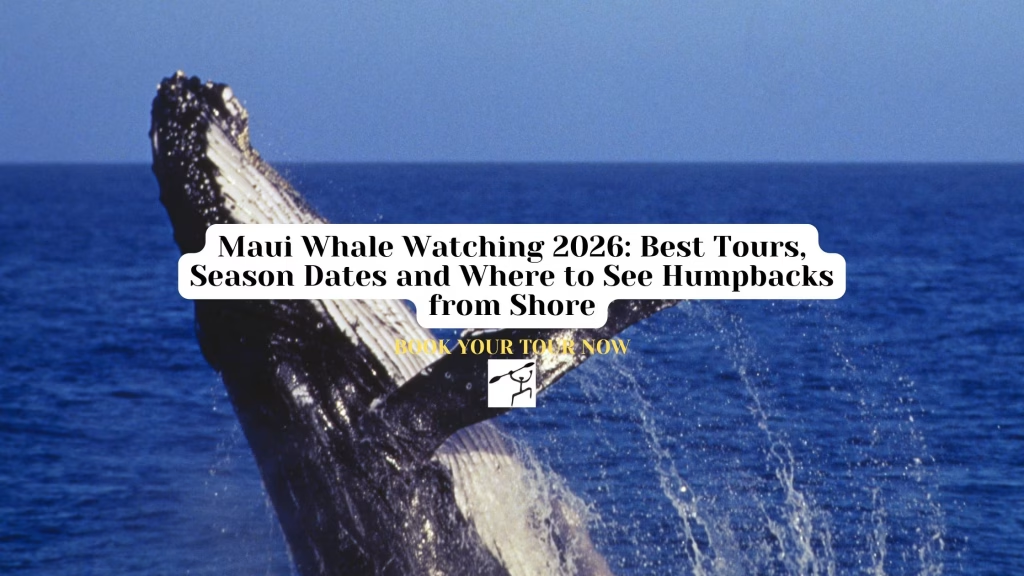
Maui whale watching in 2026 peaks between mid-December and mid-April that’s when close to 10,000 North Pacific humpbacks show up in Hawaii’s warm waters to breed, give birth, and generally put on a show. And here’s the thing most travel sites won’t lead with: you don’t need to spend a dollar to see them. Some of the best humpback sightings on the island happen from a roadside pull-off, for free, on a Tuesday afternoon.
Quick Answer: Maui Whale Watching at a Glance
- Peak season: Mid-December through mid-April (January and February are your sweet spot)
- Best free shore spot: McGregor Point Scenic Lookout, Highway 30 near mile marker 9
- Tour pricing: Roughly $45–$120 per adult depending on boat type and group size
- What you’ll actually see: Blows, breaches, pec slaps, tail lobs — and a lot of dorsal fins
- Best time for a boat tour: Early morning — the channel is calmer and whales tend to be more active
When Is Whale Season in Hawaii? Exact 2026 Dates
The official Hawaii whale watching season runs November 15 through May 15. But book a trip in late November expecting wall-to-wall action and you’ll probably be disappointed. The humpbacks trickle in gradually the first real wave shows up around mid-December, and the numbers build steadily from there.
By January, you’re in solid territory. February? That’s peak chaos, in the best way possible. Males are actively competing for females, which means you get these massive competitive pods churning up the surface, whales moving fast and breaching constantly. It’s genuinely unlike anything else.
For context on how remarkable this actually is: NOAA estimates the current North Pacific humpback population in Hawaiian waters sits around 10,000 animals. In the 1960s, that number had dropped to roughly 1,400. The recovery happened because protections worked and now you get to be the beneficiary of that on a boat in January.
March is still really good, by the way. Don’t let anyone talk you out of a March whale watch by saying the season’s winding down. We get this question so often we wrote a full post on it is March too late for whale watching in Maui? Short answer: no. Longer answer is in there, with what to expect week by week.It’s not what changes is the character of the behavior. The frenetic mating stuff mellows, and you start seeing more calves and nursing mothers. Different energy, not lesser.
If your trip lands in late May or early November, sightings are possible but not guaranteed. Those are gamble months. January and February are not.
Where to See Whales from Shore in Maui (The Free Spots That Actually Deliver)
Here’s something that surprises a lot of first-timers: during peak season, you can sometimes see humpbacks from your rental car. The channel between Maui, Lanai, and Molokai is essentially a humpback superhighway, and in January and February the whales come close sometimes within 100 yards of the shoreline.
McGregor Point Scenic Lookout is the best free whale watching spot on the island. Full stop. It’s right off Highway 30 (the Pali Highway) between Maalaea and Lahaina, near mile marker 9. The elevation gives you a wide, unobstructed view across the Auau Channel. Pull over, grab your binoculars, and scan the water in a slow, methodical grid pattern instead of just staring at one spot. Look for the white splash of a breach or the pale mist of a blow hanging briefly above the surface before it dissolves.
Papawai Point is just down the road from McGregor and worth knowing about it’s where NOAA researchers set up actual whale counting stations during peak season. If scientists are parking there with clipboards, that tells you everything about the whale traffic in that corridor.
Kamaole Beach Park III in Kihei and the Wailea Beach area on the south shore are solid options too, especially if you’re already staying on that side of the island. During the peak weeks, you can be sitting on the beach doing absolutely nothing and watch three whales breach within a 10-minute window. It happens.
Kaanapali Beach on the west side is fine for shore watching, but the resort strip and crowds make it feel less raw than the Pali Highway pull-offs. The whales don’t care, obviously but the experience feels more special when it’s just you, a clifftop, and a whale throwing itself out of the ocean.
One thing to be honest about: shore watching is passive. You wait, you watch, and some days you’ll go half an hour without seeing anything dramatic. Other days a whale will breach 200 yards in front of you and you’ll have zero photos because you were too stunned to lift your phone. Both outcomes are real. If you want consistent action and closer encounters, a boat is a different experience.
Best Whale Watching Tours in Maui: What's Worth Your Money (And What Isn't)
The best whale watching tours in Maui vary a lot more than the marketing suggests. Some operators are genuinely excellent. Some are fine. A few are just boats with a whale watching sticker and a cooler of drinks. Here’s how to actually tell the difference.
What Kind of Boat Makes Sense for You?
Raft or Zodiac boats are the most immersive option. Operators like Ultimate Whale Watch run small groups sometimes 16 people or fewer on inflatable-hull vessels that sit low on the water and can maneuver quickly when a whale changes direction. You feel every wave. You will get splashed. The encounter feels genuinely wild, not curated. That said, they’re a rough ride on choppy days and a bad choice if you get seasick easily or have mobility issues.
Catamarans are the most common setup, and for most people, the right call. They’re stable, they have restrooms, and they can carry enough passengers that the per-person cost stays reasonable. Pacific Whale Foundation operates out of both Maalaea Harbor and Lahaina Harbor, and they’re one of the most respected operators on the island their naturalist-led tours are actually educational rather than just narrated, and a portion of your ticket funds real whale research. Worth knowing before you book.
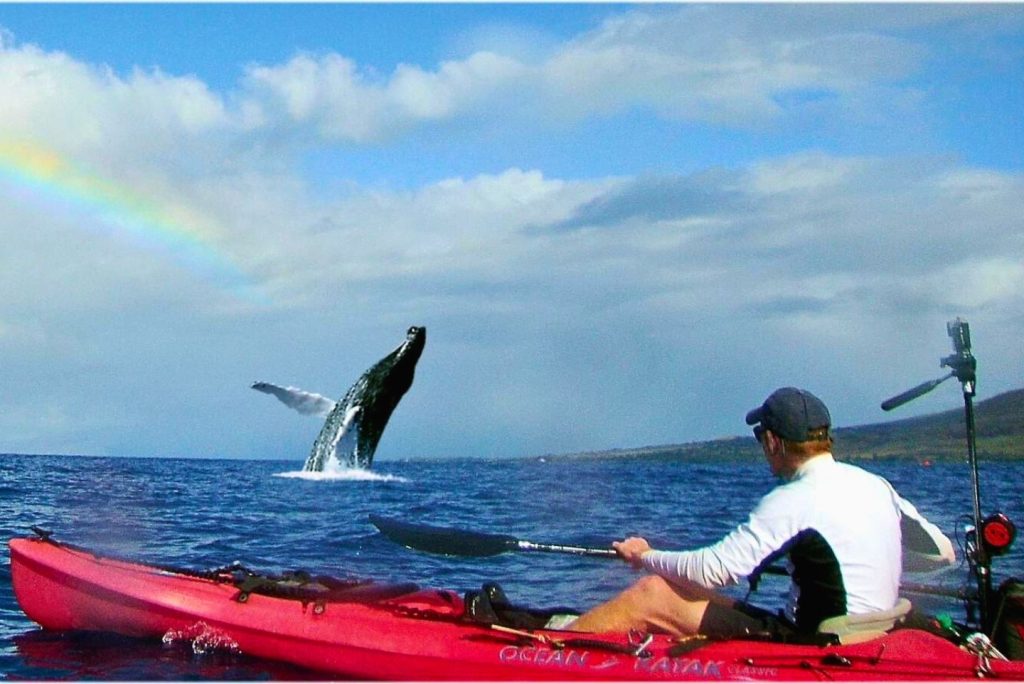
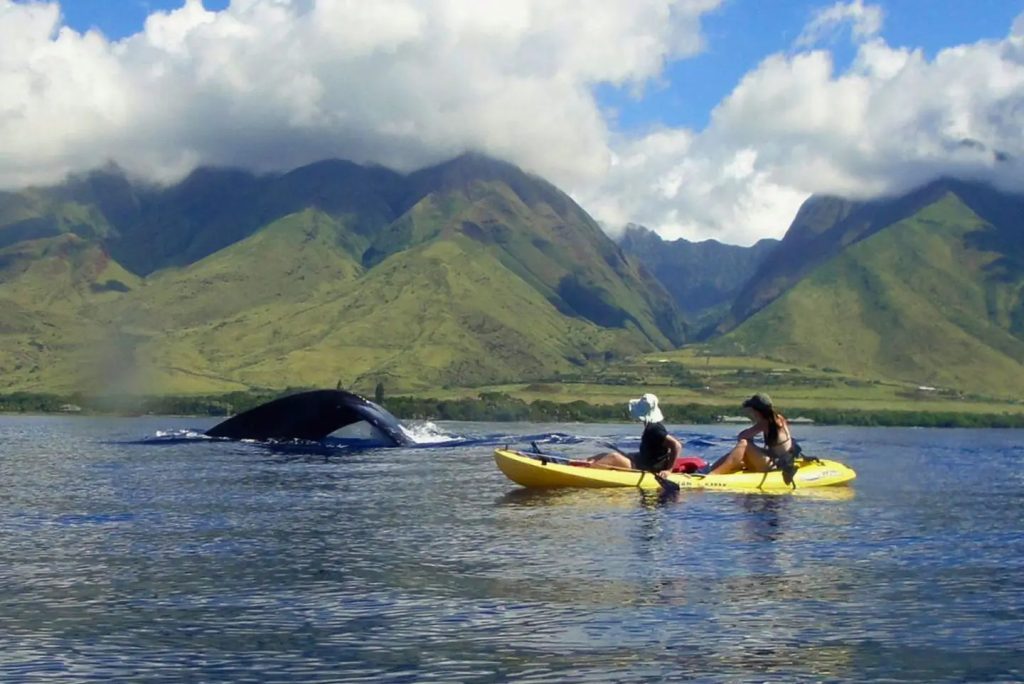
Kayak Whale Watching – Maui Adventure Tours Kayak Co. deserves a mention here because they do something genuinely different and something no other kayak company in Hawaii does. Their whale watching tours include a custom-built underwater hydrophone system that lets you hear live whale song in real time while you’re paddling. You’re not just watching a humpback from a distance; you’re floating directly above a creature that’s actively singing beneath your kayak. Tours run 3.5 hours, launch from Olowalu Beach into the Hawaiian Islands National Humpback Whale Sanctuary, and whale sightings are guaranteed from January through March. Starting at $99 with a 20% discount available online, it’s genuinely one of the more unusual and memorable things you can do in Maui during whale season.
Large motor vessels are the most stable and accessible option, especially for older travelers or those with limited mobility. The tradeoff is you’re higher above the water, farther from the animals, and sharing the experience with more people. Sightings are the same the feel of the encounter is different.
Maui Whale Watching Lahaina Harbor: What to Know for 2026
Most west Maui tours still leave from Lahaina Harbor, which puts you directly at the edge of the Auau Channel. For 2026 travelers, it’s worth knowing Lahaina town continues to rebuild. The harbor is fully operational and tours are running normally, but the surrounding area looks very different from pre-fire photos you might have seen online. Before you arrive, it’s worth reading what’s actually open in Lahaina in 2026 including which restaurants survived, where to park, and how to visit respectfully while the community is still healing. Tour operations are running normally. But if you planned on grabbing lunch in old Lahaina before or after your tour, have a backup plan. The recovery is ongoing.
If you’re booking a tour, consider making it a Lahaina-based operator rather than a large national booking platform. The money stays local, and right now, Lahaina needs that more than most places.
Maalaea Harbor on the south-central coast is the other main departure point, and it’s equally well-positioned for whale access. Less scenic to drive to, but the trips themselves are just as good.
What Does It Actually Cost?
Standard shared catamaran tours run about $45–$65 per adult for two hours. Small-group or naturalist-led trips the kind worth paying more for land in the $85–$120 range. Sunrise tours tend to sit at the lower end of the price scale and have the bonus of calmer water and better light for photos.
One thing: skip the “sunset whale watch” framing that some operators lean on. Whales don’t know it’s sunset. Morning sightings are more reliable because the seas are calmer and whale surface activity trends higher earlier in the day. The sunset packaging is marketing. Go in the morning.
Most operators worth their salt offer a sighting guarantee a free return trip if no whales appear. Pacific Whale Foundation, Trilogy Excursions, Ultimate Whale Watch, and Maui Adventure Tours Kayak Co. all offer versions of this. Ask explicitly before handing over your credit card.
What You'll Actually See Out There (Setting Real Expectations)
This section exists because a lot of people come back from whale watching slightly underwhelmed, and it’s almost always a gap between expectation and reality rather than a bad trip.
The most common thing you’ll see is a blow that column of misty vapor that shoots up when a whale exhales at the surface. Then you see the back roll slowly through and a small dorsal fin, and then the fluke lifts as the animal dives. The whole sequence takes maybe 10 seconds. Humpbacks typically stay down 5 to 15 minutes between surfacings when they’re resting or traveling.
The dramatic stuff full breaches, pec slaps, tail lobs does happen, and during peak season you’ve got a genuinely solid shot at seeing at least one spectacular behavior on any given 2-hour trip. But some days the whales are present and calm. They’re rolling and blowing and clearly there, just not performing. That’s still whale watching. Some people get back on land and feel deflated. Those people usually didn’t read this section first.
January and February tend to give you the most active, chaotic surface behavior because of the competitive dynamics between males. By March, the energy shifts toward calves — you’ll see mothers at the surface for longer, calves practicing behaviors, occasionally a calf nursing. Less dramatic visually, but in some ways more moving.
One number worth knowing: federal law under the Marine Mammal Protection Act requires vessels to stay at least 100 yards from humpbacks and 1,000 feet from mother-calf pairs. Legit operators follow this. If a boat is pushing in closer to give passengers a better look, that’s a red flag.
Practical Tips for Planning Your Whale Watch
A few things that seem obvious but aren’t until you’ve learned them the hard way.
Book before you leave home. January and February tours especially small-group options and kayak experiences fill up weeks out. There’s no walk-up magic at the harbor in peak season.
Take sea sickness medication the night before if you have any doubt about your stomach. The Auau Channel is usually calm, but “usually” is doing a lot of work there. Afternoon tours in particular can get choppy, and Dramamine works better as a preventative than a fix.
Bring polarized sunglasses. They cut the surface glare in a way that makes spotting blows dramatically easier. This sounds like a small thing until you’ve spent an hour squinting into flat silver ocean not sure what you’re looking at.
Dress in layers. January mornings on the water in Maui are cooler than they look from the beach. A light jacket, closed shoes, and a long-sleeve layer under your shirt makes the difference between enjoying yourself and counting down to getting back to shore.
Keep your binoculars accessible when you’re driving the Pali Highway between Lahaina and Kihei. The pull-offs near McGregor and Papawai Point reward spontaneity. Some of the best sightings happen through a car window with nowhere to be.
FAQ: Maui Whale Watching 2026
When is the absolute best month to see humpback whales in Maui? Honestly? February. The population is at its highest, the males are still in full competitive mode, and you’re in the middle of the peak rather than ramping up or winding down. January is a close second — slightly fewer whales but often more aggressive surface behavior as competition heats up. If you can’t do either, March is still genuinely great. Don’t sleep on March.
Can you actually see whales from the beach, or is that overhyped? It’s not overhyped at all, but location matters a lot. Random stretches of beach? Maybe, maybe not. McGregor Point or Papawai Point on the Pali Highway? During January and February, you’d almost have to be trying not to see them. Those elevated viewpoints over the Auau Channel are where the magic happens. Bring binoculars and give yourself at least 20 minutes of patient scanning.
Which Hawaiian island has the best whale watching? Maui, and it’s not really close. The Auau Channel — the stretch of water between Maui, Lanai, and Molokai — is one of the most whale-dense marine areas in the North Pacific during winter. The combination of geography, water depth, and warm calm conditions makes it perfect for humpback breeding. Maui also has by far the most tour operators and shore viewing infrastructure of any island in the chain.
How much should I budget for a whale watching tour in Maui? For a standard 2-hour shared catamaran tour, you’re looking at $45–$65 per adult. If you want a smaller group, a naturalist on board, or a kayak experience with something like Maui Adventure Tours Kayak Co., budget closer to $85–$120. Kids under a certain age (usually 2–4 depending on the operator) often ride free or at a steep discount. Most decent operators offer a free return trip if you don’t see whales — ask about that policy before you book.
Should I book whale watching tours in advance or can I just show up? Book in advance. Especially for anything in January or February, especially small-group or specialty tours. The walk-up situation in peak season is not a strategy — it’s a hope. Operators sell out, and you’ll end up on whatever’s left, which is rarely the best option. Give yourself the choice by booking a few weeks ahead of your trip.
Is whale watching okay for little kids? Yeah, it generally works great for kids — humpbacks are enormous, dramatic, and impossible to be unimpressed by when you’re seven years old. That said, pick a stable catamaran over a raft if you’re bringing young children. Two hours is about the right length before attention spans expire. Some operators have minimum ages (usually 2–4 years), so double-check before booking. And pack snacks. Always pack snacks.
If you’re traveling with a family and want the full breakdown on age limits, boat types, and which operators are genuinely set up for kids vs. just tolerating them we put together a dedicated Maui whale watching tours for kids guide worth bookmarking
What should I actually wear on the boat? Layers. People always underestimate how cool it gets on the water at 7am in January even in Hawaii. A light windbreaker, sunscreen on every exposed surface, polarized sunglasses, closed-toe shoes (the deck gets wet), and a hat. If you’re going on a Zodiac raft, assume you’re going to get splashed and dress accordingly — no white linen, no open tote bag, no phone without a case.
Are tours still running out of Lahaina Harbor in 2026? Yes — whale watching tours have continued operating from Lahaina Harbor. The harbor itself was not destroyed in the 2023 fire, and operators have been running trips throughout the recovery period. What has changed is the town around it — Lahaina looks very different than pre-fire, and many of the shops and restaurants you might remember are gone or relocated. Confirm logistics with your specific operator before you arrive, and consider booking directly with local Lahaina-based companies as a way of supporting the community’s recovery.
Bottom Line
Maui whale watching in 2026 is one of those rare travel experiences where the reality actually lives up to and sometimes exceeds what you imagined. Book early for January or February, build in at least one afternoon at McGregor Point even if you’re doing a boat tour, and go in knowing that the magic of watching a 40-ton animal clear the water isn’t something you’ll easily shake. Whether you’re on a kayak through Maui Adventure Tours Kayak Co., a catamaran with Pacific Whale Foundation, or standing at a highway pull-off in your flip-flops Maui whale watching in 2026 is absolutely worth building your trip around. Not sure how to structure the rest of your days? This 7-day Maui itinerary shows you exactly how to fit whale watching, snorkeling, the Road to Hana, and Haleakala into one trip without feeling like you’re sprinting through paradise.