

Quick Answer — What Is Turtle Town Maui?
Turtle Town Maui is a protected stretch of reef-rich coastline along South Maui’s Makena shore, running between Nahuna Point and Black Sand Beach. It is world-famous for reliable, close-up encounters with Hawaiian green sea turtles (honu) in their natural reef habitat. The best entry point for shore snorkelers is Maluaka Beach. The ideal time to visit is between 7 AM and 10 AM, year-round, when visibility peaks and turtle activity is at its highest.
Introduction: Why Turtle Town Maui Belongs on Every Snorkeler's Bucket List
Imagine gliding through crystal-clear Pacific water as a 300-pound Hawaiian green sea turtle rises slowly from the reef, hovers just below the surface to breathe, and drifts past you as if you simply do not exist. That moment unhurried, wild, and profoundly peaceful is what makes Turtle Town Maui one of the most talked-about snorkeling destinations anywhere on Earth.
But Turtle Town is far more than an Instagram backdrop. It is a thriving marine sanctuary where ancient honu have grazed on seagrass and coral algae for centuries. Understanding where it is, why turtles gather there, and how to experience it responsibly is the difference between a forgettable beach afternoon and the kind of memory you carry for the rest of your life.
This 2026 guide gives you everything: the exact location, the science behind why turtles congregate here, the best time to visit by month and by hour, step-by-step snorkeling instructions, gear advice, the legal rules, and insider tips you genuinely will not find in any other guide online.
Where Exactly Is Turtle Town Maui? Location, Beaches & Access
Turtle Town Maui sits along the southern coastline of Maui, Hawaii, in the Makena district just south of Wailea. Geographically, it spans the reef system between Nahuna Point (locally known as Turtle Point) to the north and Black Sand Beach, also called Pu’u Ola’i Beach, to the south covering roughly 1.5 miles of rich, shallow lava reef.
While the entire Makena coastline can loosely be called “Turtle Town,” three distinct beaches serve as the main access points for snorkelers.
Maluaka Beach (the #1 recommended entry point) is the gold standard for shore snorkeling at Turtle Town Maui. Protected, calm, and genuinely family-friendly, it sits closest to the highest turtle concentration and has a gentle sandy entry that works for all skill levels. Most locals and repeat visitors default to Maluaka and for good reason it consistently delivers.
Nahuna Point (Turtle Point) is a rocky headland at the northern edge of the Turtle Town zone. It offers immediate reef access and puts you directly above some of the best coral structure in the area, but the entry is over sharp lava rock and is best reserved for experienced snorkelers comfortable navigating rough entries.
Makena Landing is a small boat ramp and beach north of Maluaka, popular with kayakers and paddleboarders who want to launch and paddle south toward the turtle-rich reef. It is a calm, easy entry with good parking and facilities.
Getting to Maluaka Beach: Head south from Wailea on Wailea Alanui Drive, which becomes Makena Alanui Drive. Turn right onto Honoiki Street, follow it to the end, then turn left onto Makena Road. The beautiful old stone Keawala’i Church will appear on your right. The free public parking lot is directly across the street. From the lot, walk south along Makena Road for about 200 meters and you are at the beach. GPS coordinates: 20.6178°N, 156.4412°W.
Facilities at Maluaka include free parking, restrooms, and outdoor showers. There is no lifeguard on duty and no food vendors, so plan accordingly. The closest restaurants are at the Makena Beach & Golf Resort, which is adjacent to the beach.
Why Do Sea Turtles Gather at Turtle Town? The Ecology Behind the Name
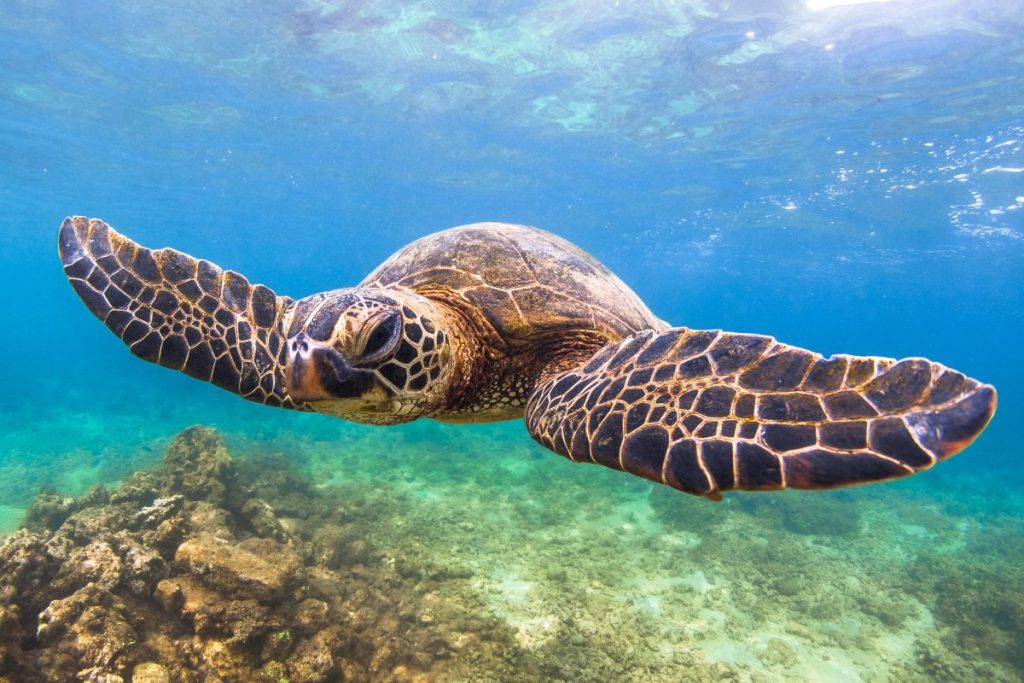
Hawaiian green sea turtles called honu in Hawaiian are not scattered randomly around Maui’s coastline. They gather at specific reef zones for deliberate ecological reasons, and the Turtle Town reef checks every single box on their list.
The reef here is blanketed in limu (Hawaiian seaweed) and coral algae, which form the primary diet of adult green sea turtles. Honu can spend hours grazing in as little as two to eight feet of water, which is why shallow areas hold just as many turtles as the deeper sections a fact that surprises most first-time visitors.
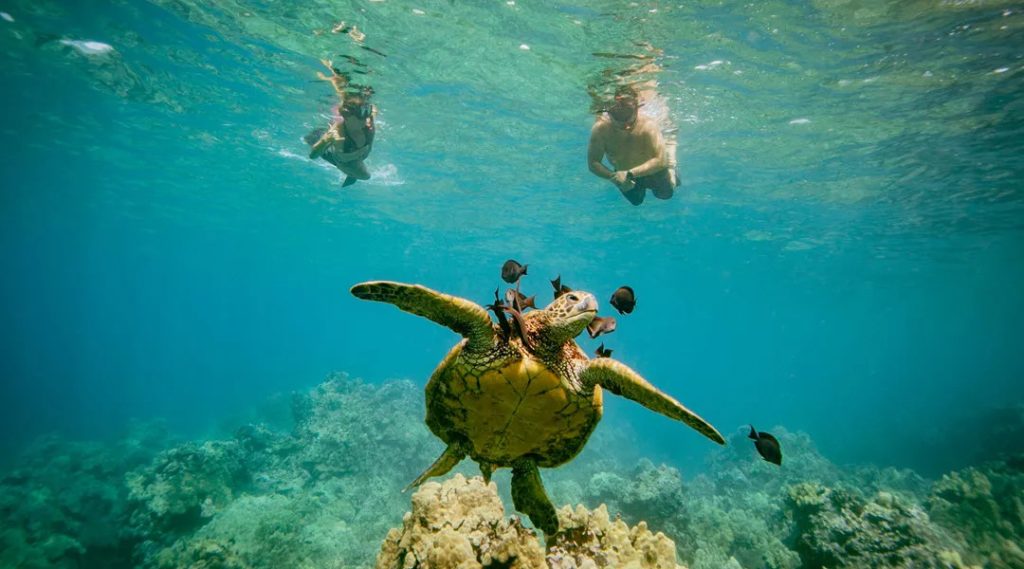
Certain coral heads within the Turtle Town reef function as what marine biologists call cleaning stations. Yellow tang, surgeonfish, and convict tang gather at these spots to pick parasites and algae from turtle shells. If you see a turtle hovering motionless near a specific coral head with a cluster of small fish around it, you are watching a living car wash in action. These stations are one of the main reasons turtles return to the same reef day after day.
The geography of the Makena coast also plays a major role. Haleakala volcano shields this section of shoreline from Maui’s dominant northeast trade winds, creating a pocket of calm, protected water that feels entirely different from the choppier northern shores. That consistent calm allows turtles to feed close to shore without being disturbed by surge or surface turbulence.
Finally, Hawaiian green sea turtles are protected under the federal Endangered Species Act. Because human harassment of these animals carries serious legal consequences, they have been allowed to habituate to careful snorkeler presence over decades. The result is a turtle population that is noticeably unafraid and those unhurried, up-close encounters are precisely what makes Turtle Town Maui so extraordinary. On a typical morning, encountering five to twenty honu in a single ninety-minute snorkel session is entirely realistic.
Best Time to Visit Turtle Town Maui — Hour, Season & Month Breakdown
Hawaiian green sea turtles called honu in Hawaiian are not scattered randomly around Maui’s coastline. They gather at specific reef zones for deliberate ecological reasons, and the Turtle Town reef checks every single box on their list.
The reef here is blanketed in limu (Hawaiian seaweed) and coral algae, which form the primary diet of adult green sea turtles. Honu can spend hours grazing in as little as two to eight feet of water, which is why shallow areas hold just as many turtles as the deeper sections a fact that surprises most first-time visitors.
Certain coral heads within the Turtle Town reef function as what marine biologists call cleaning stations. Yellow tang, surgeonfish, and convict tang gather at these spots to pick parasites and algae from turtle shells. If you see a turtle hovering motionless near a specific coral head with a cluster of small fish around it, you are watching a living car wash in action. These stations are one of the main reasons turtles return to the same reef day after day.
The geography of the Makena coast also plays a major role. Haleakala volcano shields this section of shoreline from Maui’s dominant northeast trade winds, creating a pocket of calm, protected water that feels entirely different from the choppier northern shores. That consistent calm allows turtles to feed close to shore without being disturbed by surge or surface turbulence.
Finally, Hawaiian green sea turtles are protected under the federal Endangered Species Act. Because human harassment of these animals carries serious legal consequences, they have been allowed to habituate to careful snorkeler presence over decades. The result is a turtle population that is noticeably unafraid and those unhurried, up-close encounters are precisely what makes Turtle Town Maui so extraordinary. On a typical morning, encountering five to twenty honu in a single ninety-minute snorkel session is entirely realistic.
How to Snorkel Turtle Town Maui: A Step-by-Step Guide for Beginners and Pros
The most common mistake visitors make at Turtle Town is entering the water at the wrong spot. Here is the exact approach that maximizes your chance of a great turtle encounter.
Step 1 — Walk south to the rocks. When you arrive at Maluaka Beach, resist the urge to jump in at the first sandy patch. Instead, walk south along the beach until you reach the rocky outcropping at the southern end of the sand. This is your entry point. The sandy mid-beach section has little marine life because turtles and reef fish prefer structure over open sand. The reef begins at those rocks, and that is where the action is.
Step 2 — Enter carefully and head south. Wade in from the rock-sand transition zone where the bottom is still sandy but reef begins nearby. Once in the water, swim south. You will be tracking along a gentle lava reef slope that drops from about three feet to twenty feet over a comfortable distance. This gradual slope means you can snorkel at whatever depth you find comfortable.
Step 3 — Look shallow, not just deep. This is the single most important insider tip for Turtle Town Maui. The vast majority of first-time snorkelers look only in deep water for sea turtles, assuming large animals must be in large water. They are wrong. Hawaiian green sea turtles feed on seaweed in as little as two to three feet of water and rest motionless on shallow reef ledges where their dark, mottled shells are nearly indistinguishable from lava rock. Slow down, scan the reef methodically, and inspect every flat, dark shape before moving on. You will be astonished how many turtles you swim past without realizing.
Step 4 — Find the cleaning stations. Look for clusters of small fish hovering above a particular coral head with unusual intensity. That concentration almost always means a turtle is below them, parked on the reef and being cleaned. Approach slowly from the side rather than from above — turtles, like most marine animals, are more startled by overhead approach, which mimics predator behavior.
Step 5 — Be patient and still. The best turtle encounters happen when you are horizontal, breathing slowly, and producing minimal splash. Turtles that would swim away from an active, splashing snorkeler will often drift directly toward a calm, motionless one out of simple curiosity. Float. Wait. Let them come to you.
Step 6 — Know when to give space. If a turtle begins swimming away quickly, repeatedly changes direction, or shows any sign of agitation, back off immediately. Under the Endangered Species Act, approaching within ten feet of a sea turtle intentionally or failing to yield their path is a federal violation carrying fines up to $50,000. Beyond the legal dimension, your behavior directly affects the animal’s health chronic stress suppresses turtle immune systems and increases their vulnerability to disease.
Marine Life You'll Encounter Beyond the Turtles
Turtle Town Maui snorkeling offers a complete reef ecosystem experience, not just turtles. The biodiversity here is genuinely remarkable for the mid-Pacific.
On the fish side, expect to encounter the Humuhumunukunukuapua’a (Hawaii’s state triggerfish), Moorish idols, parrotfish, surgeonfish, butterflyfish, damselfish, wrasse, trumpetfish, the dazzling yellowtail coris, and large schools of convict tang. Moray eels peer from lava tube crevices. Goatfish root through sandy patches for buried invertebrates.
Among invertebrates, long-spined sea urchins colonize the deeper sections of the reef give them a wide berth. Pencil sea urchins, sea cucumbers, and Christmas tree worms embedded in coral are all common. Octopus are present but rarely visible, typically hiding in small lava holes and matching the rock perfectly.
Occasional sightings that generate lasting excitement include spotted eagle rays gliding through the blue water column, white-tipped reef sharks resting on sandy patches (harmless and generally nocturnal), and Hawaiian spinner dolphins who occasionally venture close to shore in small groups. On truly lucky days, humpback whales can be heard singing underwater during winter months (December through April), even if they are not visible.
The coral itself cauliflower coral, rice coral, antler coral, and encrusting coralline algae forms a dense, colorful backdrop to all of this life. This is a healthy reef, and it shows.
Essential Snorkeling Gear for Turtle Town Maui (2026)
Your gear choices meaningfully affect your experience. Here is what actually matters for this specific location.
“The most important piece of equipment is your mask. A mask that does not seal properly to your face will flood constantly, ruining the experience. Not sure whether to go with a traditional mask or a full-face design?
Read our breakdown of are full face snorkel masks better before you buy.”
If you are renting gear, try the mask before you leave the shop by pressing it to your face without the strap and inhaling gently it should hold suction against your skin. If it does not, try another. Bringing your own mask on a snorkeling trip is one of the single best investments you can make.
For fins, open-heel adjustable fins are the most versatile and comfortable for the rock entry at Maluaka’s south end. Closed-heel booties help if you have sensitive feet and plan to walk over the lava rock entry. Avoid kicking your fins near the reef even gentle fin contact kills coral polyps and stirs up silt that can cloud the water for everyone behind you.
Reef-safe sunscreen is not optional in Hawaii it is the law. As of 2021, Hawaii prohibits the sale of sunscreens containing oxybenzone and octinoxate, chemicals proven to bleach coral reefs. Use mineral-based sunscreen with zinc oxide, or better yet, cover up with a UPF 50+ rash guard and eliminate sunscreen from the equation entirely. “A rash guard also protects against the mild jellyfish and hydroids that occasionally drift through the area if you’re unsure what to pack, our full guide on what to wear snorkeling covers every essential item.”
A snorkel vest or safety vest is strongly recommended for children and adults who are not confident swimmers. Water depth in the turtle zone ranges from very shallow to about twenty feet, but even confident swimmers benefit from the effortless floating a vest provides it lets you focus entirely on what is below rather than on staying afloat.
Bring an underwater camera. A GoPro or the Olympus Tough TG series (waterproof to 50 feet without a housing) will capture images and video that will stun your friends back home. Turtle Town genuinely rewards the effort of bringing camera equipment.
Gear rental is available in Kihei and Wailea, about ten to twenty minutes from Maluaka. Full snorkel sets typically rent for $10–$20 per day. Tour operators often include gear in package prices if you book a boat excursion.
Snorkeling Tour vs. DIY Shore Snorkeling — Which Should You Choose?
Both approaches deliver genuine results. The right choice depends on your experience level, budget, and what you want from the experience.
Choose a guided snorkeling tour if you are a beginner or non-swimmer who would feel more comfortable with professional guidance. Tours also make sense if you want to combine Turtle Town with a visit to Molokini Crater in a single day, want narration and wildlife education, or simply want all logistics handled. Maui Adventure Tours Kayak Co. , Pride of Maui, Quicksilver, and Trilogy Excursions all run Turtle Town routes from Maalaea Harbor, typically departing at 7 or 8 AM.
Choose DIY snorkeling from Maluaka Beach if you are a confident swimmer with your own gear, are traveling on a budget, or want to arrive before the tour boats and stay through the entire prime morning window without being tied to a departure schedule. Beach access is entirely free, and the shore snorkeling at Maluaka consistently matches or exceeds what tour boats offer because you control your timing.
The honest verdict from people who have done both: the DIY approach at Maluaka, executed early in the morning with the right entry point, produces some of the highest-quality turtle encounters anywhere in Maui. Tour boats are excellent for reaching the outer reef and for Molokini, but for Turtle Town itself, showing up at dawn with your own mask gives you a meaningful edge.
Rules, Regulations & Ethical Snorkeling at Turtle Town
Hawaiian green sea turtles are listed as threatened under the federal Endangered Species Act and are additionally protected by Hawaii state wildlife law. These are not suggestions violations carry fines up to $50,000 and in serious cases, criminal prosecution.
The rules are straightforward. Do not touch, ride, push, or physically interact with sea turtles under any circumstances. Maintain a minimum distance of ten feet. Do not block a turtle’s path to the surface as air-breathing reptiles, they must surface regularly and an obstructed path is a genuine threat to their safety. Do not feed turtles. Do not use direct flash photography toward their eyes. If you see a turtle that appears injured, entangled, or distressed, do not intervene yourself report it to NOAA’s Hawaiian Islands Stranding Response at 1-888-256-9840.
Beyond the legal requirements, the ethical dimension matters. Chronic stress caused by repeated human harassment suppresses turtle immune systems, making honu more vulnerable to fibropapillomatosis a debilitating tumor disease already affecting populations across Hawaii. How you behave in the water directly affects the long-term health of the animals that make Turtle Town what it is. Treat the encounter as a privilege, not an entitlement.
What Else Is Near Turtle Town Maui?
Keawala’i Church, located directly across from the Maluaka Beach parking lot, is a beautifully preserved Hawaiian Congregational church built in 1832. The stone architecture and surrounding cemetery are genuinely moving, and a five-minute visit before or after your snorkel adds meaningful cultural context to the day.
Big Beach (Oneloa Beach), about a half-mile south of Maluaka, is one of Maui’s most dramatic and beautiful stretches of sand. Do not attempt to snorkel here the shore break can be powerful and dangerous. Visit for the scenery and the surf.
Little Beach, a clothing-optional cove tucked over the lava rock hill at Big Beach’s northern end, hosts a beloved Sunday sunset drum circle that draws locals and visitors alike. Worth experiencing at least once.
Ahihi-Kinau Natural Area Reserve, further south along the coast, is a protected marine preserve with some of the most pristine reef on Maui. Access has been regulated in recent years check current DLNR permit requirements before visiting, as rules change.
The Makena Beach & Golf Resort fronts the Turtle Town coastline directly and is the only resort in the immediate area. Non-guests are welcome on the public beach. The resort restaurant is a good option for post-snorkel lunch or a sunset cocktail.
10 Insider Tips for Turtle Town Maui Snorkeling in 2026
1. Arrive before 8 AM without compromise. The difference in crowd levels, parking availability, and water clarity between 7 AM and 11 AM is not marginal it is dramatic.
2. Walk all the way to the south end of the beach before entering. Mid-beach entry is the most common mistake and the one most responsible for “we didn’t see any turtles” reports.
3. Check ocean conditions before you go. The iWindsurf app and Magic Seaweed both provide south shore swell data. Swells above three feet can make even Maluaka choppy. Save the trip for a calm day.
4. Anti-fog your mask before every session. Apply saliva, rub gently, and rinse or use commercial defogger. Fogged masks are responsible for more missed turtle sightings than any other single factor.
5. Look behind you periodically. Turtles frequently surface directly behind distracted snorkelers. Flip around and check every few minutes.
6. Minimize fin kicking near the reef. Even slight contact with coral kills polyps. Practice hovering with minimal fin movement before you reach the turtle zone.
7. Wear bright colors. Honu are genuinely curious about vivid yellows, oranges, and pinks. Multiple snorkelers report turtles approaching and investigating brightly colored fins and rash guards.
8. Breathe slowly and stay horizontal. A calm, horizontal snorkeler looks like drifting debris to marine life non-threatening and ignorable. A vertical, splashing snorkeler clears the reef instantly.
9. Bring water and snacks. There are no vendors at Maluaka Beach. The walk back to the car feels considerably longer when you are dehydrated. Pack a cooler.
10. If you don’t see turtles in ten minutes, keep moving south. The density increases significantly as you snorkel further along the reef past the rocky entry point. Patience and forward movement are always rewarded.
Frequently Asked Questions About Turtle Town Maui
Is Turtle Town Maui an actual town? No. Turtle Town is not a formal town, city, or official geographic designation. It is a colloquial nickname used by locals, tour operators, and snorkelers for the reef-rich stretch of Makena coastline where Hawaiian green sea turtles reliably congregate. The nearest actual town is Wailea, approximately three miles north.
What is the difference between Turtle Town and Maluaka Beach? Turtle Town refers to the broader coastal reef zone between Nahuna Point and Black Sand Beach. Maluaka Beach is one specific white-sand beach within that zone the most popular and accessible entry point. Most people use the terms interchangeably in casual conversation, but technically Maluaka Beach is one access point within the larger Turtle Town area.
Is snorkeling at Turtle Town safe for beginners? Yes, under calm conditions. Maluaka Beach is one of Maui’s most beginner-friendly snorkeling spots because it is sheltered from trade winds, has a gentle sandy entry, and offers a gradually sloping reef without strong currents. Beginners should always snorkel with a buddy, wear a snorkel vest if their swimming confidence is limited, and avoid entering if the water looks choppy or surgy. There is no lifeguard on duty.
Can I see turtles from shore without snorkeling? Sometimes. Honu occasionally surface close to shore or bask on the rocks near the southern end of Maluaka Beach, and they can be spotted from land. However, snorkeling dramatically increases your chances of an extended, close encounter since turtles spend the majority of their time beneath the surface.
Is it legal to swim with sea turtles in Maui? Swimming in the general vicinity of sea turtles is legal, provided you maintain a minimum distance of ten feet and do not chase, touch, feed, or interfere with them in any way. Deliberately approaching within ten feet or blocking their path violates the federal Endangered Species Act. Respectful, passive observation from a considerate distance is both legal and strongly encouraged.
When are the most turtles at Turtle Town Maui? Honu are present year-round. Sightings and turtle activity peak in late spring through early summer (April through June) and again in early autumn (September through October). Summer months bring high turtle activity but also the largest crowds. Winter months (December through March) remain excellent for turtle sightings, though some days may see rougher water from winter swells.
Is there parking at Maluaka Beach? Yes. A free public parking lot sits across from Keawala’i Church on Makena Road. A second overflow lot is available further south near the southern beach access. Both lots fill quickly on weekends and holidays arriving before 8 AM makes parking effortless.
What marine life besides turtles will I see at Turtle Town Maui? The reef supports exceptional biodiversity including Hawaii’s state fish the Humuhumunukunukuapua’a, parrotfish, Moorish idols, surgeonfish, butterflyfish, moray eels, spotted eagle rays, octopus, and occasionally white-tipped reef sharks and Hawaiian spinner dolphins in the open water just offshore.
Final Take: Is Turtle Town Maui Worth It?
Absolutely without hesitation, and without qualification.
Turtle Town Maui delivers one of the most accessible, consistently rewarding, and genuinely wild wildlife encounters anywhere on Earth. No boat required. No dive certification. No expensive tour package. No advanced swimming ability needed. Just an early morning, a well-fitting mask, and the willingness to float quietly above one of Hawaii’s most extraordinary living reefs.
What separates this place from every other so-called “turtle beach” in the world is the combination of density, habituation, and habitat quality that simply does not exist at the same level anywhere else in Hawaii. The honu here are not tolerating human presence in the best encounters, they are entirely indifferent to it, carrying on with feeding, cleaning, and resting as if you are simply another piece of the reef they live on.
Come early. Move slowly. Breathe deeply. And when a 300-pound ancient reptile drifts past you on its way to the surface, pause for a moment and take it in fully. You are a guest in its world. Treat it that way, and Turtle Town Maui will give you something no photograph however beautiful can fully capture.